What to see near Lucca
5 min · 9 Feb 2024
What to see around Lucca? Here are 5 beautiful places not far from Lucca that we highly recommend you visit.
Capannori
A little more than 5 kilometres from Lucca is the municipality of Capannori, whose vast territory stretches from the Pizzorne Plateau to the Monti Pisani, occupying a large part of the Piana di Lucca. It comprises no less than forty hamlets, each with its own characteristics that make it unique. The Capannori countryside is characterised by the presence of remarkable architectural structures, the most evident of which is the monumental Roman-style aqueduct built by the architect Lorenzo Nottolini. The Capannori area also contains a large number of villas built between the 15th and 19th centuries. Among these, it is impossible not to mention the Villa Reale in Marlia, Villa Mansi and Villa Torrigiani. Other works that characterise the area are the parish churches, among which the very ancient Pieve di San Gennaro stands out, inside which is a terracotta statue that could be by Leonardo da Vinci. Finally, the Athena Archaeological Museum is also worth a visit, with exhibits ranging from Prehistory to the early Middle Ages.
Montecarlo
Located about 15 kilometres from Lucca, Montecarlo is a charming medieval village known for the vast vineyards that characterise its landscape and the production of fine PDO wines: Montecarlo Bianco and Rosso di Montecarlo. The well-preserved historical centre, still surrounded by a beautiful city wall, rises on the Cerruglio Hill, which gives its name to the Cerruglio Fortress, the symbol of the village. This imposing construction consists of a semicircular main tower, the keep and two square twin towers. Within the historical centre, a visit to the Collegiate Church of Sant’Andrea and the Teatro dei Rassicurati is a must, even better if during one of the performances. At the foot of Colle del Cerruglio stands the Romanesque Pieve di San Piero in Campo, one of the oldest churches in Tuscany.
Borgo a Mozzano
Considered due to its position the gateway to the Media Valle del Serchio, Borgo a Mozzano is a small village about 20 kilometres from Lucca. The symbol of the village is the mysterious Ponte della Maddalena (Magdalen Bridge), built between the 11th and 12th centuries by Countess Matilda of Canossa but rebuilt in the early 14th century by Castruccio Castracani. It is one of the most original constructions in the whole of Tuscany and is also known as the Devil’s Bridge because of an ancient legend, according to which the master builder was helped by the devil to complete the work. Other things to see include: the Church of San Jacopo, which preserves valuable 16th-century wooden sculptures; the Church of San Rocco, a splendid building in late Baroque style, the result of an 18th-century reconstruction; and the Museum of Memory, which preserves the traces and memories of what happened in the Media Valle del Serchio during World War II.
Bagni di Lucca
Located just over 25 kilometres from Lucca, Bagni di Lucca is one of the most renowned tourist resorts in the Garfagnana. The town has been famous since Roman times for its thermal waters, which acquired great importance after the French Revolution, when Elisa Baciocchi, Napoleon’s sister, made Bagni di Lucca a holiday resort and one of the focal points of social life. Among the sights to see are: the splendid Art Nouveau complex of the Real Casinò, inaugurated in 1839; the Ponte delle Catene, one of the oldest iron bridges still standing, built from 1844 to 1860 to a design by Lorenzo Nottolini; and the Demidoff Chapel, built in the first half of the 19th century at the behest of the Russian prince Niccolò Demidoff (hence the name).
Barga
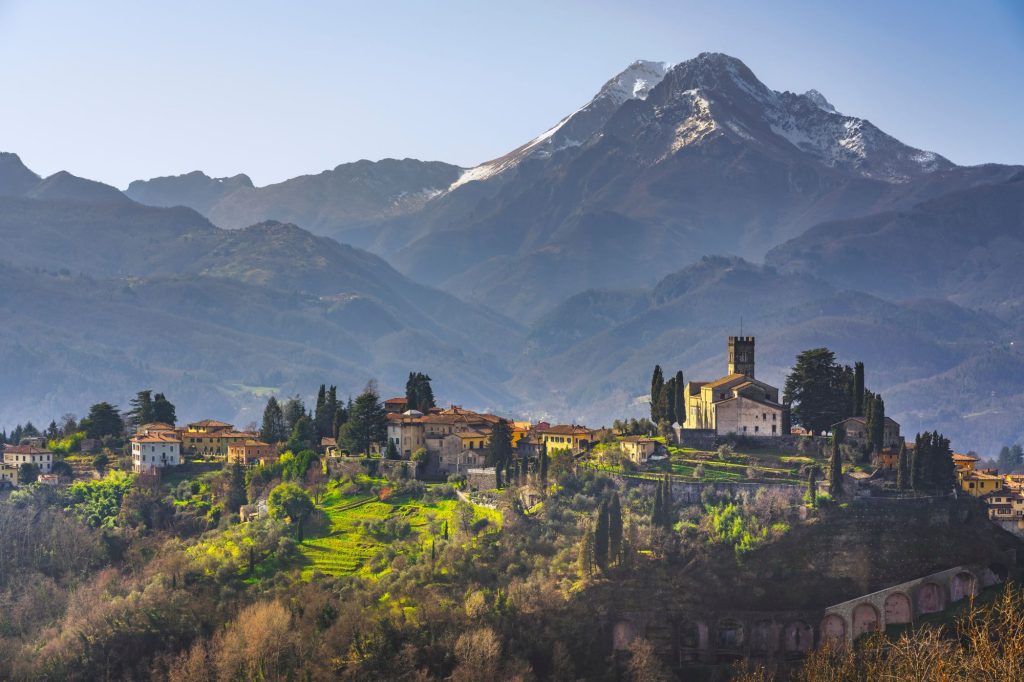
Listed among “I Borghi più Belli d’Italia” (Italy’s Most Beautiful Villages), Barga is a small medieval jewel set against the breathtaking backdrop of the Apuan Alps. The great poet Giovanni Pascoli was so fascinated by it that he spent 17 years of his life there. It is located just over 30 kilometres from Lucca and is rich in splendid artistic testimonies. The main attraction is the Cathedral of San Cristoforo, built several times from the 11th to the 16th century. It has an Alberese stone façade that changes colour depending on the weather and offers a spectacular view of the Apuan Alps and the Apennines. Other sights to see include: the Conservatorio di Santa Elisabetta, where you can admire a stupendous altarpiece from the Della Robbia school; the Casa Museo Giovanni Pascoli, which still retains the spaces and furnishings left by the poet; and the Museo Civico del Territorio Antonio Mordini, set up in the evocative rooms of the medieval Palazzo Pretorio, where important evidence of Barga’s historical events is preserved.