Trekking in Tuscany: the most beautiful routes
7 min · 30 May 2023

Tuscany is world famous for its monuments, works of art, picturesque villages, delicious food, excellent wines and breathtaking landscapes. But it is also and above all one of the most popular destinations for those who love nature, mountains and trails. The region is full of hiking trails, more or less long and more or less frequented, revealing environments of rare beauty. Wherever you choose, do not forget the basic rule of the perfect hiker: do not litter or pollute, and always respect nature.
But which are the most beautiful trekking routes in Tuscany? Let’s discover them together.
THE VIA FRANCIGENA
One of the most beautiful routes through Tuscany is undoubtedly the Via Francigena, the ancient Roman pilgrimage route that starts from Canterbury Cathedral and ends in Rome. The official route, faithful to the one narrated by Archbishop Sigeric, is about 1,800 km long, of which a good 380 are in Tuscany. In the Middle Ages, the Via Francigena was travelled as a sort of act of penance, while today, although there are still believers who cross it driven by religious motivations, it is an opportunity for a renewed relationship with nature. The Tuscan section joins the mountains of Lunigiana to the hills of the Val d’Orcia. Among the most suggestive stages are the one from Massa to Camaiore and the one from San Miniato to Gambassi Terme.
The stages of the Via Francigena in Tuscany
THE PATH OF THE HOLY FACE
Another fascinating route is the ‘Cammino del Volto Santo’ (Holy Face Trail), which crosses northern Lunigiana and Garfagnana and leads to Lucca where, since 752, the relic of the Holy Face has been venerated, the ancient wooden crucifix kept in the Cathedral of San Martino, which, according to legend, was sculpted by Nicodemus. It is also known as the ‘Via Francigena di Montagna’. The route, which starts in the town of Pontremoli, is divided into 10 stages and follows the locations of the ancient parish churches: the parish church of Sorano, the parish church of San Cassiano, the parish church of Venelia, the parish church of Soliera and the parish church of San Pietro di Castello. Among the most beautiful stages is the one connecting Castelnuovo di Garfagnana to Barga. The stages do not present any objective difficulties.
GARFAGNANA TREKKING
Garfagnana Trekking is a large ring-route around the valley marked by the Serchio river, touching the most significant peaks of the Apuan Alps and the Tuscan-Emilian Apennines. The route starts and returns to Castelnuovo di Garfagnana, a delightful medieval village surrounded by an evocative circle of mountains. Subdivided into 9 stages involving five/seven hours of walking, it makes it possible to complete the entire tour of the valley, linking the Apuan Alps Regional Park and the Tuscan-Emilian Apennines National Park. We recommend the stage that leads from the CAI Enrico Rossi Refuge to Isola Santa: it takes place through scenery of extraordinary beauty and uniqueness.
The stages of Garfagnana Trekking
THE GREAT ELBAN CROSSING
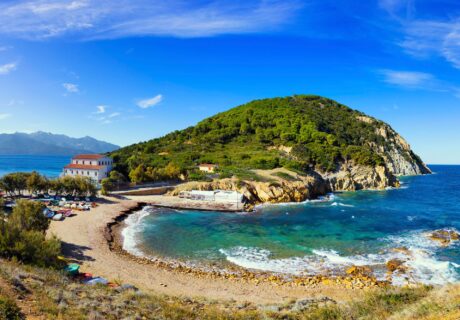
Another place that offers wonderful walking opportunities is the Island of Elba: a green and blue oasis in the waters of the Tuscan Archipelago, where nature reigns supreme. One of the most beautiful hiking trails on the island, if not in Italy, is the Grande Traversata Elbana. It is a ridge that joins most of Elba’s paths and allows you to observe the island’s extraordinary geological, vegetational and morphological variety. The route is 50 to 60 km long, depending on the variants you decide to take, and is divided into four stages. It can be crossed in its entirety in four or five days, but can also be done in single stages, as it is well connected to the towns, where it is possible to use public transport to return to the place of stay.
The route of the Great Elban Crossing
RENAISSANCE RING
Another route not to be missed is the Anello del Rinascimento, a fascinating walk through Florence and the surrounding area. The itinerary consists of a main ring (8 stages for about 130 km), to which are added 5 variants and 3 additions, for a total of 250 km. Each section, if covered separately, offers the possibility of reaching Florence thanks to public transport connections. It is of considerable interest for both the naturalistic and artistic aspects, as it crosses the landscapes that were the inspiration for the great Renaissance masters. The route conventionally begins and ends at the Castle of Calenzano and has as its central reference point the dome of the Florence Cathedral, symbol of the city.
The stages of the Renaissance Ring
THE WAY OF THE GODS
The Via degli Dei is a wonderful route connecting Emilia Romagna and Tuscany, passing through the Apennines. Conceived in the late 1980s, it mainly follows ancient routes used in the Middle Ages and even earlier by the Romans and Etruscans. The route is divided into five stages and is so called because some of the localities touched upon bear names of clear classical mythological inspiration, such as Monte Adone, Monzuno (Mons Iovis, mount of Jupiter), Monte Venere and Monte Luario (Lua was the Roman goddess of expiation). Enchanting landscapes and views are encountered along the way, but also a series of archaeological sites of great historical value such as the Roman theatre and the acropolis of Fiesole. Among the most beautiful stages is the one that leads from the historical centre of San Piero a Sieve to Florence.