The monumental cemeteries of Florence
5 min · 26 Sep 2024
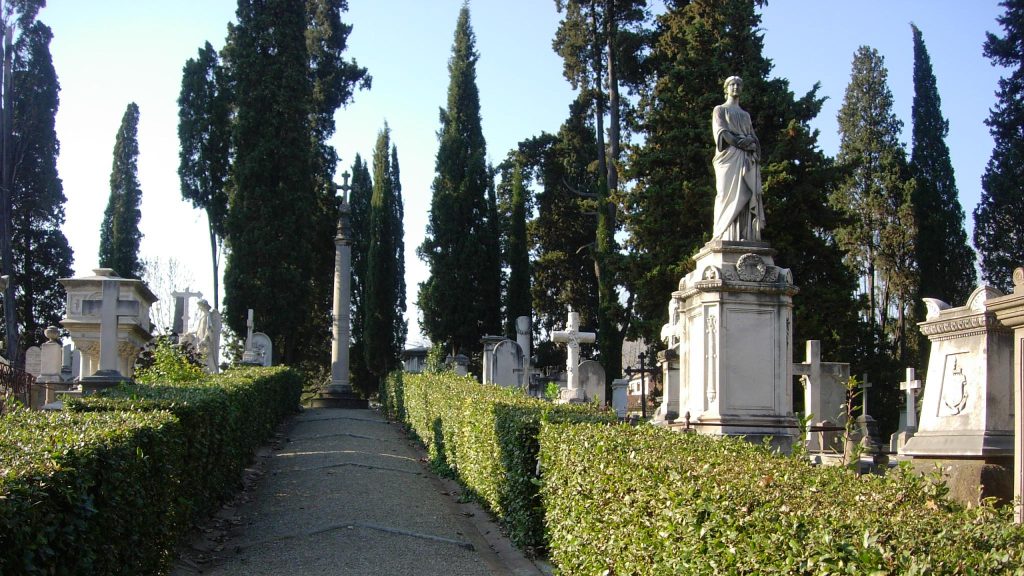
What to see in Florence? What we are proposing is undoubtedly an unusual itinerary, off the beaten track but undoubtedly of great interest, that will guide you to discover Florence’s monumental cemeteries. Authentic monuments of art, true open-air museums, they are places of memory that invite to silence, meditation, prayer and that hide, among the many burials, names of illustrious personalities from the international world of art and culture.
The English Cemetery
Located in Piazzale Donatello, the English Cemetery is a silent island in the chaos of city traffic that owes its name to the countless British citizens buried there. It was opened in 1827 by the Swiss Reformed Church of Florence and closed in 1877, following the new urban regulations that moved burial places at least 100 metres away from built-up areas. It was designed by architect Carlo Reishammer although its current shape is due to Giuseppe Poggi, who redesigned it on the occasion of the construction of Piazzale Donatello (1870). Many famous people are buried there, such as Elizabeth Barrett Browning, Walter Savage Landor, Frances Trollope, Thomas Southwood Smith, Hiram Powers and Giovan Pietro Vieusseux. But it is the presence of the statues, the irregular arrangement of the burials, the layout of the paths and the various tree essences that make the place so evocative. A small curiosity: the unusual shape of the cemetery and its romantic spectral charm inspired Arnold Böcklin to paint ‘The Island of the Dead’, a masterpiece of late 19th-century European symbolism.
The Evangelical Cemetery at Allori
Immediately after the closure of the English Cemetery, the Evangelical Cemetery at Allori was opened (in 1878). It served to give dignified burial to non-Catholics who were not accepted by the city’s cemeteries. Designed by the Florentine engineer Giuseppe Boccini, it took its name from the place where it was built, the Podere degli Allori. It is located on the Via Senese, on the outskirts of Florence (near Galluzzo), and is considered a veritable open-air museum. The most important Tuscan sculptors (Fantacchiotti, Romanelli, Betti, Costoli, Maraini) left their mark there along with other foreign sculptors who had chosen Florence as their adoptive city. Many personalities are buried there, including the well-known collector Frederick Stibbert, the writer Harold Acton, the art historian Herbert Percy Horne, the painter Arnold Böcklin (author of the famous painting ‘The Island of the Dead’ inspired by the English Cemetery), the architect Leonardo Savioli, the writer Oriana Fallaci and the painter Elizabeth Boott Duveneck. Originally a Protestant cemetery, since 1970 it has welcomed believers of all religious denominations together with non-believers.
The Cemetery of the Holy Doors
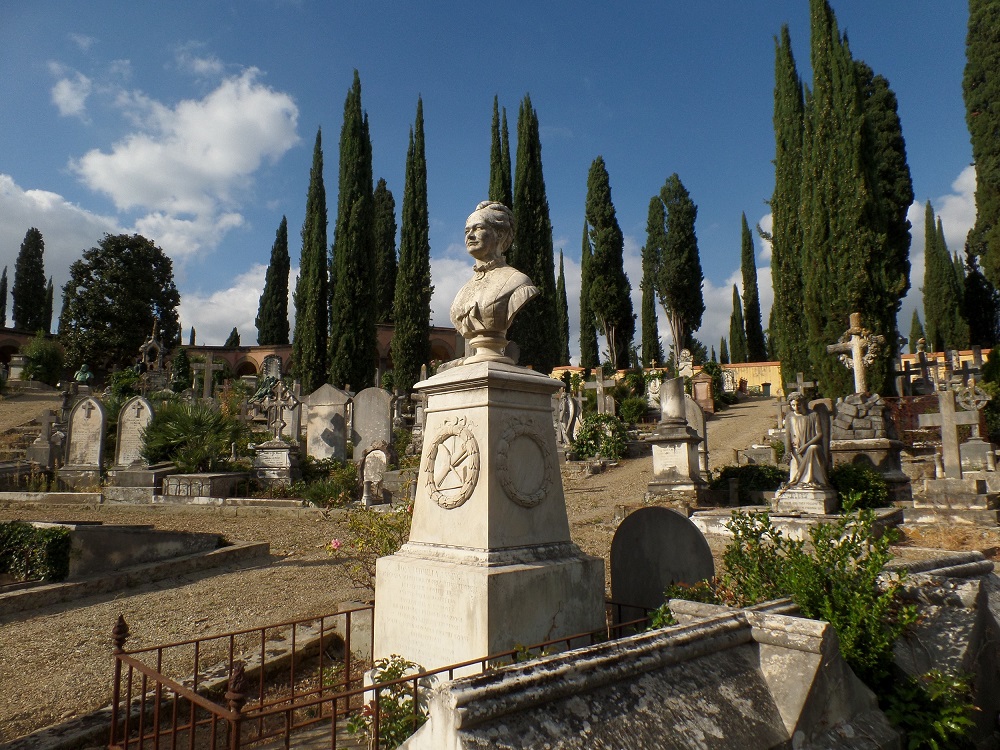
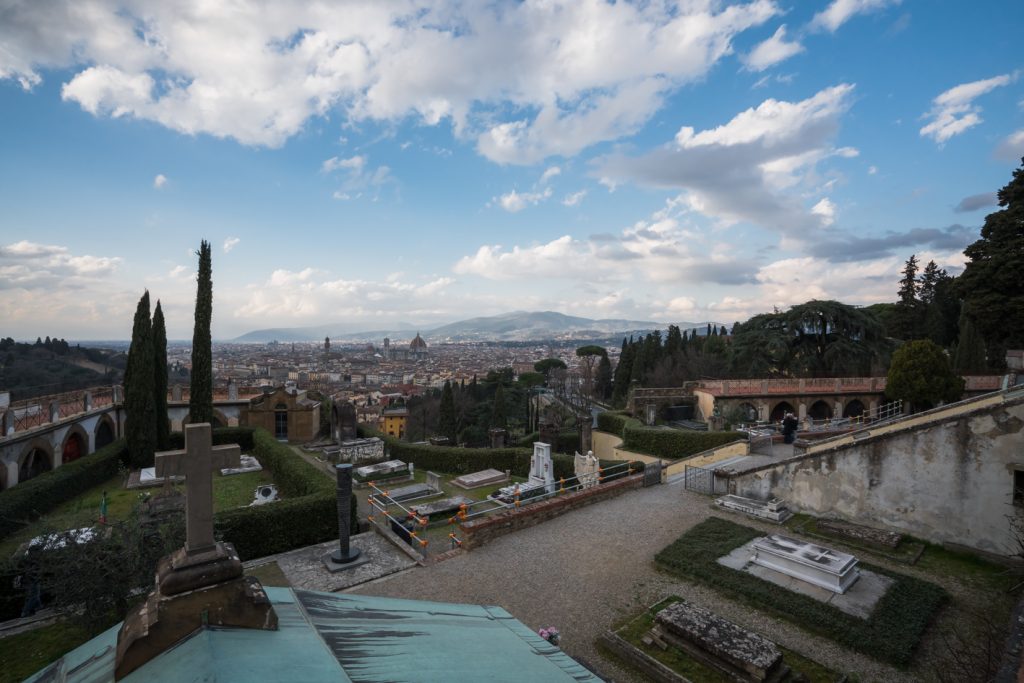
Situated in a panoramic position on the hill of San Miniato al Monte, the Cemetery of the Holy Doors develops in the area surrounding the Romanesque basilica of the same name and the adjoining Palazzo dei Vescovi. Designed by architect Niccolò Matas (known for having been the creator of the façade of the Basilica di Santa Croce), it was inaugurated in 1848 and then enlarged in 1864 by architect Mariano Falcini. It offers a vast panorama of sculpture from the second half of the 19th century, particularly for stone and metal materials. But let us come to the illustrious people buried there. Among the most famous are: Carlo Lorenzini (better known as Carlo Collodi, the author of Pinocchio), the writer Vasco Pratolini, the painter Ottone Rosai, the sculptor Libero Andreotti, the politician Giovanni Spadolini, the film producer Mario Cecchi Gori, the father of Italian cuisine Pellegrino Artusi, the fashion designer Enrico Coveri, the actor Paolo Poli and the director Franco Zeffirelli. The most scenic part of the cemetery is below the façade of San Miniato.
The Monumental Cemetery of Mercy of Antella
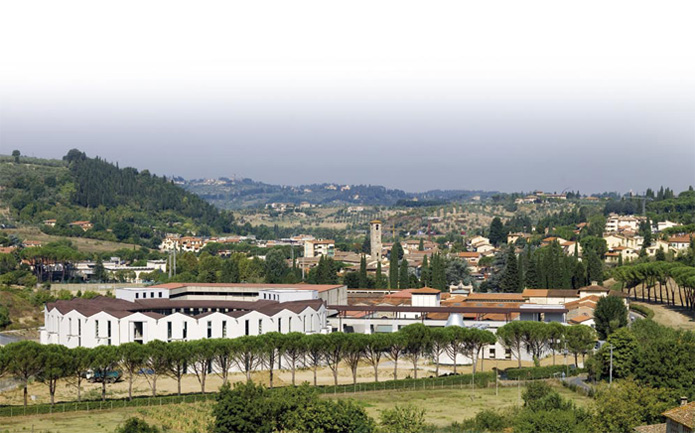
In addition to these three, we also recommend the Monumental Cemetery of Mercy of Antella (a hamlet of the municipality of Bagno a Ripoli), located about 10 kilometres from the centre of Florence. Renowned for its size and the works of art it preserves, it is considered the second most important monumental cemetery in Italy, after the Verano Cemetery in Rome. Built between 1855 and 1856 at the behest of the parish priest Don Giuseppe Scappini to a design by municipal engineer Giovacchino Callai, it has been repeatedly enlarged over time. It houses most of the religious-themed production of Galileo Chini, one of the major representatives of Art Nouveau in Italy. Various family members are buried in the cemetery, as well as Galileo Chini himself who died in 1956. Other outstanding burials include the literary critic Isidoro Del Lungo, architect Luigi Del Moro, composer Stanislao Gastaldon, publisher Raffaello Maurri, art historian Enrico Ridolfi, poet Pietro Mastri, playwright Francesco Coletti and soprano Marianna Barbieri Nini.
Main photo © Feel Floreence | Photo Gallery © (1 and 2) Feel Floreence – (3) Misericordia di S. Maria all’Antella