10 things to see in Florence
9 min · 21 Oct 2024
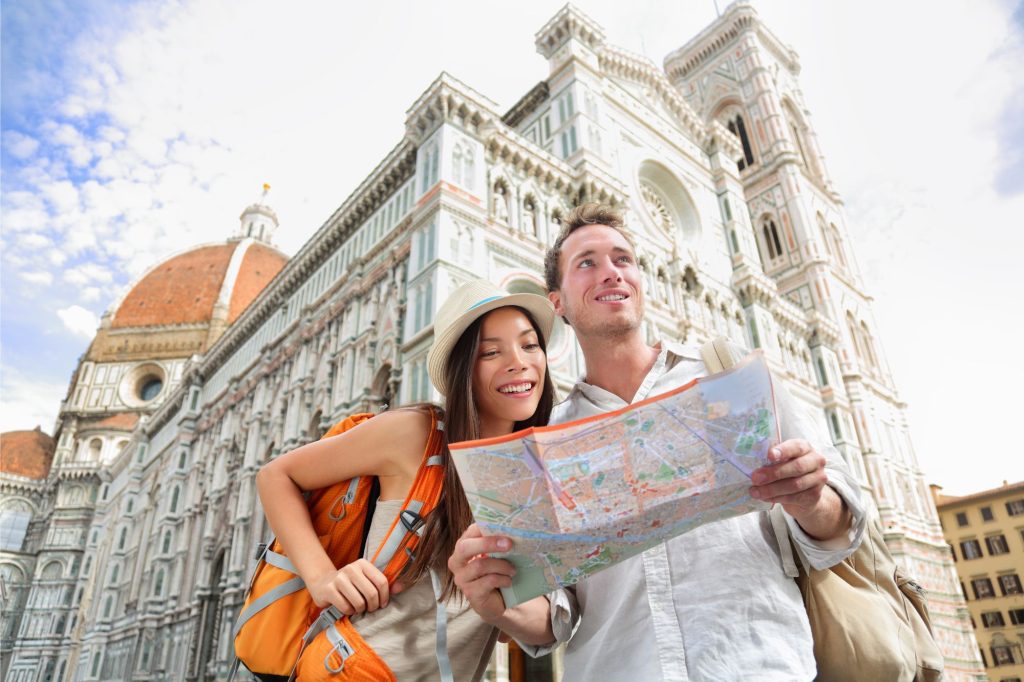
Cradle of art and beauty and home to countless artists, Florence is rich in museums, monuments, churches and masterpieces. There are so many things to see that a month would not be enough to visit it from top to bottom. The secret lies in not pretending to see everything. Here we have selected 10 things that for no reason in the world you can miss!
PIAZZA DEL DUOMO & ITS MONUMENTS
Our guide to discovering Florence can only begin in Piazza del Duomo, the spiritual heart of the city and the soul of its historic center. At a glance, one can admire the most important religious buildings in Florence. The square is dominated by the bulk of the Cathedral of Santa Maria del Fiore, one of the largest churches in the world as well as one of the greatest masterpieces of Italian Gothic architecture. Even from the outside, the visual effect is stunning, while the interior holds an extraordinary artistic heritage. Its dome, one of the works that belong to the best riches of the human, was designed by Filippo Brunelleschi in the 15th century. Next to the cathedral stands Giotto’s Bell Tower, another excellent example of Gothic architecture. Opposite the cathedral, however, is the Baptistery of San Giovanni, a masterpiece of Italian Romanesque architecture characterized by a fascinating geometric structure with an octagonal plan.
PIAZZA DELLA SIGNORIA
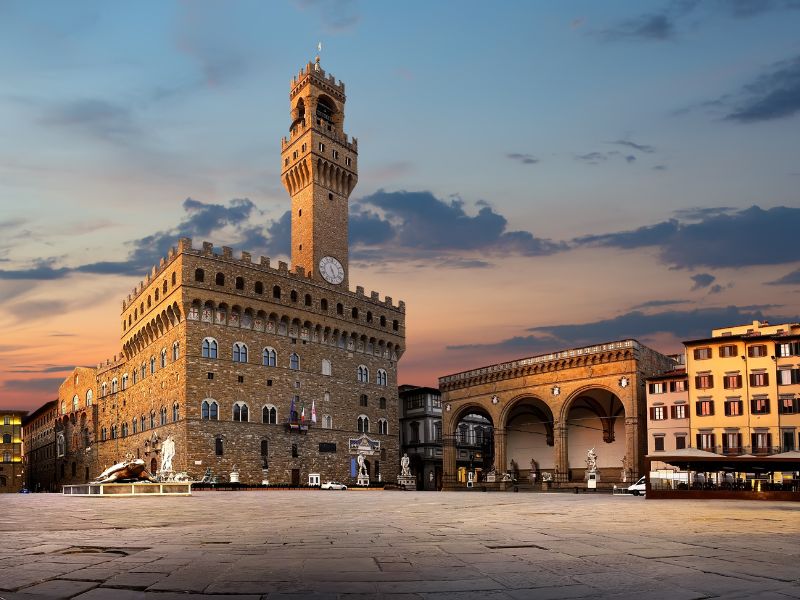
The beating heart of Florence since the Middle Ages, Piazza della Signoria is one of the landmarks of the lily city. It astonishes with its imposing proportions and the amount of artistic heritages that face it. The main monument that can be admired in the square is Palazzo Vecchio. Built in the late 13th and early 14th centuries, the building is the result of numerous and complex modifications over time. A former ducal residence, it now houses the seat of the City Council and a very valuable museum that traces the political events and artistic history of Florence. Opposite the entrance to Palazzo Vecchio is the Loggia dei Lanzi, where several sculptures can be admired, the most important of which is surely the Perseus, a masterpiece by Benvenuto Cellini considered to be one of the main works of Italian Mannerist sculpture. In the center of the square are: the equestrian monument of Cosimo I, created by Giambologna; and the Fountain of Neptune, created by Bartolomeo Ammannati and some of his pupils.
THE UFFIZI
The Uffizi is considered one of the most prestigious and important art venues globally. The gallery occupies the first and second floors of the palace of the same name built between 1560 and 1580 to a design by Giorgio Vasari. In its rooms one can admire extraordinary collections of ancient sculptures and paintings (ranging from the medieval to the modern period). Particularly noteworthy are the collections of 14th-century and Renaissance paintings, which include absolute masterpieces of the art of all times by artists such as Giotto, Simone Martini, Piero della Francesca, Beato Angelico, Filippo Lippi, Botticelli, Mantegna, Correggio, Leonardo, Raphael, Michelangelo and Caravaggio. Among the most famous works: the double portrait entitled The Dukes of Urbino Federico da Montefeltro and Battista Sforza by Piero della Francesca; the Madonna of the Goldfinch by Raphael; Michelangelo’s Tondo Doni; and Titian’s Venus of Urbino.
PONTE VECCHIO
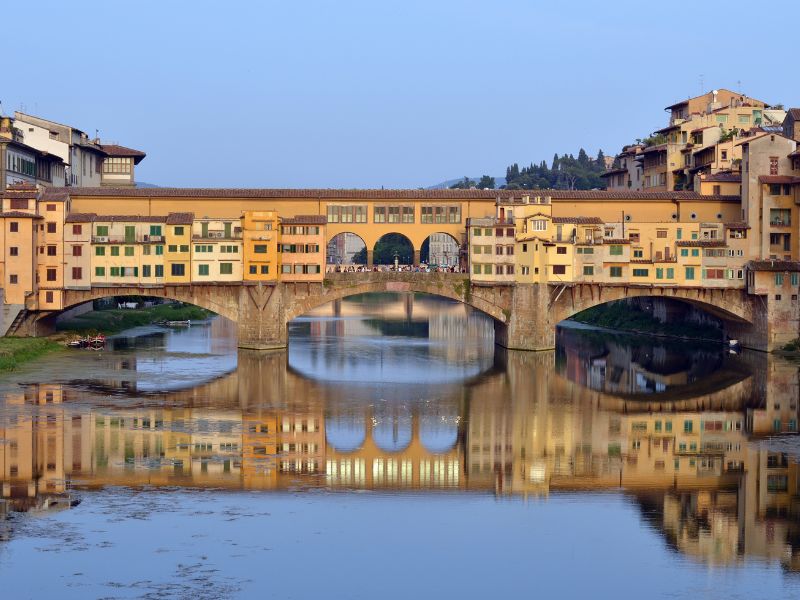
Ponte Vecchio, with its exclusive goldsmiths‘ and jewellers’ workshops, is the place one passes by sooner or later, each time offering a panoramic and romantic viewpoint over the city. As we know it, albeit with later alterations, it was erected between 1339 and 1345, possibly to a design by Taddeo Gaddi, after a flood had destroyed the previous one (a bridge in that position had stood since Roman times). It connects the historical centre with the eastern part of the city, called ‘Diladdarno’ by the Florentines. During the day it is crowded with people on the move, while at dusk, when the wooden doors of the shops close, it is quiet and becomes one of the most atmospheric places in Florence. The bridge is topped by the Corridoio Vasariano, an elevated walkway designed in 1565 by Giorgio Vasari that connects Palazzo Vecchio to Palazzo Pitti.
BASILICA OF SANTA CROCE
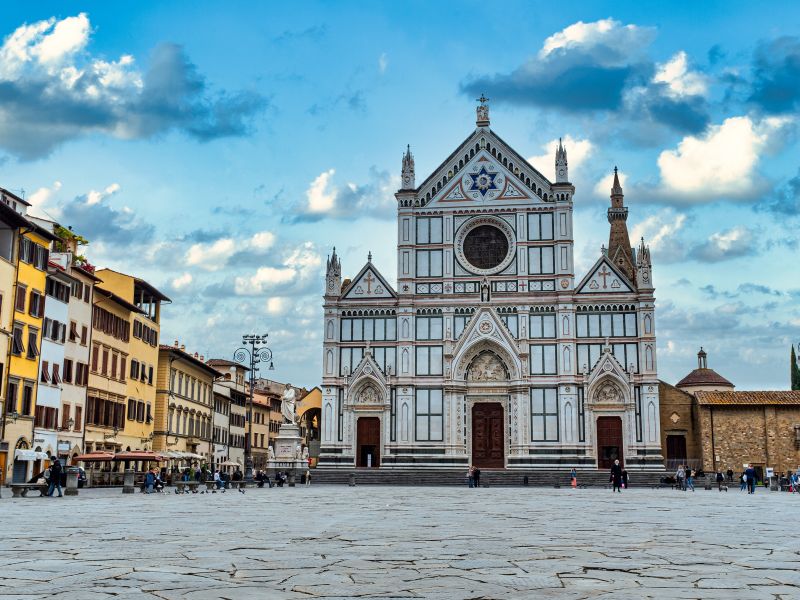
Besides being one of the landmarks of Florence and its history, the Basilica of Santa Croce is one of the greatest achievements of the Gothic style in Italy. Located in the square of the same name, it was built starting in 1295 to a design by Arnolfo di Cambio and, although it was consecrated in 1443, it remained unfinished until the mid-19th century, when architect Niccolò Matas covered the façade with polychrome marble, enriching it with pinnacles and crowning it with the Star of David. The basilica is known as the Temple of Italic Glories because of the numerous tombs of great artists, men of letters and scientists it contains (Machiavelli, Galileo, Michelangelo, Rossini, etc.). It houses almost 4,000 works ranging from the 13th to the 20th century, including Donatello’s Annunciation of the Virgin and Giotto’s frescoes in the Peruzzi Chapel (depicting scenes from the lives of St. John the Baptist and St. John the Evangelist) and the Bardi Chapel (facts from the life of St. Francis according to the Legenda Maior by Bonaventura da Bagnoregio).
BASILICA OF SANTA MARIA NOVELLA
The Basilica of Santa Maria Novella is one of the most important churches in the city and stands in the square of the same name, near the station that bears its name. It was completed in 1357 but has undergone several transformations over the following centuries, in particular the renovations carried out by Giorgio Vasari starting in 1566 and the 19th century restorations aimed at restoring a Gothic appearance to the building. Giotto, Brunelleschi, Masaccio, Michelangelo, Ghirlandaio, Botticelli and Vasari are just some of the names associated with the basilica’s rich artistic history. Among the most valuable works are: Giotto’s Crucifix datable to around 1290-1295, one of the artist’s earliest known works; the Trinity by Tommaso Guidi, known as Masaccio, datable to 1425-1426, universally considered to be one of the fundamental works for the birth of the Renaissance; and Brunelleschi’s Crucifix datable to around 1410-1415, which according to Vasari was carved in response to Donatello’s Crucifix of Santa Croce, which the artist criticised for its exaggerated naturalism.
GALLERY OF THE ACADEMY
Un altro museo da non perdere è la Gallery of the Academy, la cui nascita risale al 1784, quando il Granduca di Toscana Pietro Leopoldo riorganizzò l’Accademia delle Arti del Disegno nella moderna Accademia di Belle Arti. Ubicata nel centro storico, a pochi passi da Piazza San Marco, è conosciuta nel mondo come “Museo di Michelangelo” perché ospita il maggior numero di sculture dell’artista rinascimentale, tra cui il celeberrimo David, considerato da molti l’oggetto artistico più bello mai creato dall’uomo. Oltre ai capolavori di Michelangelo, si segnalano: la prestigiosa collezione di dipinti a fondo oro dal Duecento al primo Quattrocento; la collezione di modelli e calchi in gesso di Lorenzo Bartolini e del suo allievo, Luigi Pampaloni; gli strumenti musicali dei granduchi Medici e Lorena; e il modello in terra cruda del Ratto delle Sabine del Giambologna.
BOBOLI GARDEN
Florence is not only the cradle of art but also a city extraordinarily rich in gardens. Among these is the enchanting Boboli Garden, which extends behind the Pitti Palace. Beloved by Florentines and tourists alike, it is one of the most important and oldest examples of formal Italian gardens in the world and a veritable open-air museum. It was started in the 16th century at the behest of the Medici and extended by the successive Lorraine and Savoy dynasties. Architects such as Vasari, Ammannati and Bernardo Buontalenti worked on its realisation. The vast green area contains ancient and Renaissance statues, grottoes and fountains. Of particular note are: the 18th-century Kaffeehaus pavilion, a rare example of the Rococo style in Tuscany; the Limonaia, built by Zanobi del Rosso between 1777 and 1778; the Fountain of the Ocean by Giambologna; and Buontalenti’s Grotto, a masterpiece of Mannerist architecture and culture.
PIAZZALE MICHELANGELO
Piazzale Michelangelo is one of the most famous vantage points in the lily city. From here you can enjoy a breathtaking view of Florence and some of its main monuments (the Cathedral of Santa Maria del Fiore, Palazzo Vecchio, Ponte Vecchio, etc.). Located at the apex of the so-called Viale dei Colli, it was designed by the Florentine architect Giuseppe Poggi in the second half of the 19th century, when the Tuscan capital was the capital of Italy. At the centre of the square is a monument composed of bronze copies of some of Michelangelo’s most famous works: the four allegories of the Medici chapels of San Lorenzo and the David, which looks out over the hills opposite the city. We recommend you go there at sunset: the view will leave you speechless!
ABBEY OF SAN MINIATO AL MONTE
Finally, you cannot miss the Abbey of San Miniato al Monte, dedicated to the first Florentine martyr. It is located in one of the highest places in the city, a few steps from Piazzale Michelangelo, and is one of the best examples of Florentine Romanesque architecture. Built between the 12th and 13th centuries, it is an authentic masterpiece both outside and inside. It has a magnificent façade covered in white and green Prato marble with a mosaic depicting San Miniato, the Virgin and Christ in the centre, while inside it holds valuable works of art, including: the glazed terracotta vaults by Luca della Robbia in Michelozzo’s Chapel of the Crucifix; Spinello Aretino’s frescoes on the Life of St Benedict in the sacristy; and Paolo Uccello’s precious cycle of frescoes adorning the upper cloister.